
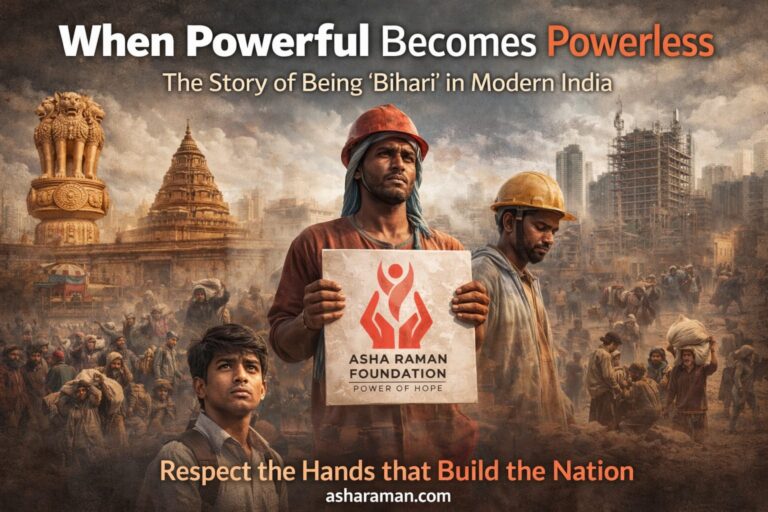
At first glance, this statement feels provocative, even unfair. But when placed in the context of Bihar’s journey—from the epicenter of ancient power to a symbol of modern marginalization—it begins to reflect a deeper, uncomfortable truth about perception, identity, and inequality in India.
There was a time when Bihar stood at the heart of Indian civilization. The land of Magadh gave rise to empires that shaped the subcontinent. Under Ashoka, governance, diplomacy, and moral philosophy reached remarkable heights. It was here that Chanakya crafted political doctrines that are still studied today. The ancient university of Nalanda University attracted scholars from across the world. Bihar was not just powerful—it was influential, intellectual, and foundational to India’s identity.
Yet, in today’s India, the word “Bihari” often carries a very different meaning.
The transformation did not happen overnight. Decades of economic stagnation, political instability, and lack of industrial growth pushed Bihar into a cycle of underdevelopment. Opportunities shrank, and migration became a necessity rather than a choice. Millions left their homes in search of survival, not success.
And in this migration lies the paradox.
The Bihari, once rooted in a land of power, now enters cities as labor—building roads, laying bricks, driving growth. In cities like Delhi, Mumbai, and Bengaluru, their contribution is everywhere, yet their presence is often invisible. They are essential to the economy, but rarely respected within it.
This is where power becomes powerless.
A Bihari worker may physically construct a high-rise building, but socially, he stands at the bottom of that very structure. His labor commands the skyline, but his identity invites stereotypes. The shift is not about capability—it is about perception.
Language plays a critical role in this transformation. Over the years, media and popular culture have reduced Bihar’s rich linguistic diversity—Bhojpuri, Maithili, Magahi—into exaggerated accents used for humor. The “Bihari” character is often portrayed as unrefined, loud, or comical. Rarely is he shown as educated, sophisticated, or aspirational.
Such portrayals shape reality.
A young student from Patna entering a metro city quickly learns that his accent can define how he is treated. To fit in, he modifies his speech, hides his origins, and distances himself from his own identity. This quiet erasure is a form of social survival.
The digital age has only amplified this phenomenon. Social media thrives on labels, and “Bihari” has often been turned into a meme category. Rural aesthetics, economic struggle, or cultural differences are repackaged as “cringe content.” What should evoke empathy is turned into entertainment.
This normalization of ridicule strips dignity from identity.
Another layer to this powerlessness is systemic bias. The historical tag of “backwardness” continues to influence how Bihar is perceived in education and employment. Even high-achieving students from the state sometimes face skepticism, as if their success must be questioned. Isolated incidents are generalized, and an entire population bears the burden of a few narratives.
In such an environment, education becomes not just a tool for growth, but an escape route.
Yet, despite these challenges, there is resilience.
The Bihari identity has not disappeared—it has adapted. From civil services to academia, from entrepreneurship to arts, individuals from Bihar continue to excel across fields. They carry forward a legacy of intellect and perseverance, even when recognition is delayed or denied.
This resilience challenges the very idea of powerlessness.
Because the truth is, the Bihari is not inherently powerless. The power has been obscured, not erased. It lies in the ability to endure, to rebuild, and to contribute despite systemic barriers.
The real issue, then, is not about Bihar alone. It is about how society defines power.
Is power only about wealth, urban polish, and social acceptance? Or does it also include the strength to survive adversity, to support families across distances, and to keep moving forward despite bias?
If the latter is true, then the Bihari is far from powerless.
The statement—“When powerful becomes powerless is called Bihari”—is less a definition and more a reflection of societal failure. It exposes how quickly respect can turn into ridicule when circumstances change. It reveals how identity can be reshaped not by reality, but by perception.
To truly address this, India must move beyond symbolic pride in Bihar’s past and extend genuine respect to its present. The legacy of Ashoka and the brilliance of Chanakya should not exist in contrast to the lived experiences of millions today.
Power should not be measured only in history books.
It should be visible in how a person is treated in everyday life.
Until a “Bihari” can carry his identity without fear of judgment, the transformation from powerful to powerless will remain incomplete—not as a truth, but as an indictment of society itself.
Gunja Jha
Insightfultake.com