
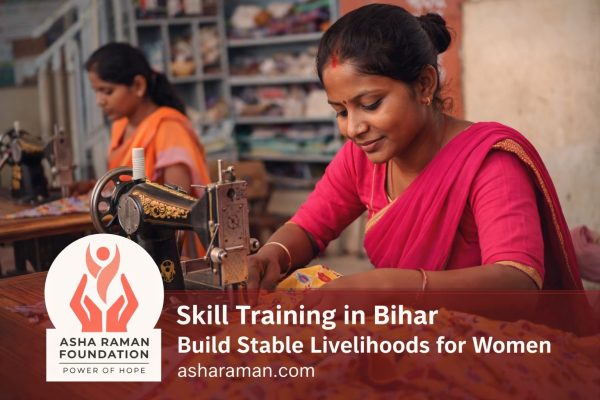
The real change is measured not by announcements but by outcomes at the household level. In Bihar, one of India’s most densely populated and economically challenged states, women continue to face limited access to education, employment, and financial independence. In such a scenario, Skill development has emerged as one of the most effective ways to address this gap, especially when driven by local organizations that understand community realities.
Data from national labour surveys shows that female workforce participation in Bihar remains significantly lower than the national average. A majority of women are engaged in unpaid domestic work or informal activities with irregular income. Social expectations, early marriage, lack of vocational exposure, and limited mobility restrict women’s entry into stable employment. As a result, families often depend on a single earning member, making them vulnerable owing to economic shocks.
Skill-based training offers a practical solution. Unlike long academic programs, skill development focuses on abilities that can be applied immediately. Tailoring, handicrafts, food processing, basic digital skills, and small-scale entrepreneurship are examples of work that can generate income without requiring migration or large investments. Studies across India show that households with skilled women tend to have better financial planning, improved nutrition, and higher school attendance among children.
Asha raman Foundation works within this context in Bihar, focusing on empowering women through practical and locally relevant skill training. It recognizes that women’s empowerment cannot follow a one-size-fits-all model. Training must align with local demand, cultural conditions, and available resources. By tailoring these programs into community needs, the foundation ensures that skills learned translate into real opportunities.
The training approach emphasizes practice over theory. Women learn through hands-on sessions that help them gain confidence and competence. This method is particularly important for participants with limited formal education. Learning through practical approach reduces fear, builds self-belief, and encourages consistency. For many women, it is their first experience of structured learning in a supportive environment.
Economic independence, even at a modest level, has a visible impact on household dynamics. Women who earn contribute to daily expenses, education costs, and healthcare decisions. This contribution gradually shifts their role within the family. Decision-making becomes more balanced, and women gain greater respect. Over time, these changes strengthen family stability and reduce dependence on external support.
Research on vocational education highlights that community-based training centers perform better than distant institutions. Accessibility plays a key role in participation. When training locations are nearby, women are more likely to attend regularly without compromising safety or household responsibilities. Asha raman Foundation’s local presence helps overcome common barriers such as travel distance, social restrictions, and lack of awareness.
Despite its importance, skill development programs face challenges. Training requires tools, instructors, learning materials, and follow-up support. Limited funding often restricts how many women can be reached. Grassroots organizations depend heavily on donations and community involvement to sustain their efforts. When funding gaps arise, programs risk slowing down or stopping altogether.
Asha raman Foundation focuses on responsible use of resources to maximise impact. Contributions are directed toward training that leads to measurable outcomes rather than temporary assistance. Even small donations can support materials, mentoring, and skill application. Collective support allows programmes to continue and expand to new communities.
In Bihar’s development journey, empowering women through skills is not optional. It is essential for economic resilience and social progress. When women are equipped to earn and decide, families become stronger and communities more stable. Asha raman Foundation’s work demonstrates how local initiatives can create lasting change by investing in women’s potential rather than short-term relief.
Skill development is ultimately about dignity and opportunity. It allows women to shape their own futures and contribute meaningfully to society. Supporting such initiatives means supporting growth that is inclusive, practical, and deeply connected to real lives. Through focused training and community engagement, Asha raman Foundation continues to help women in Bihar move from learning to livelihood, and from dependence to confidence.
Gunja Jha
Editor- Insightfultake.com