
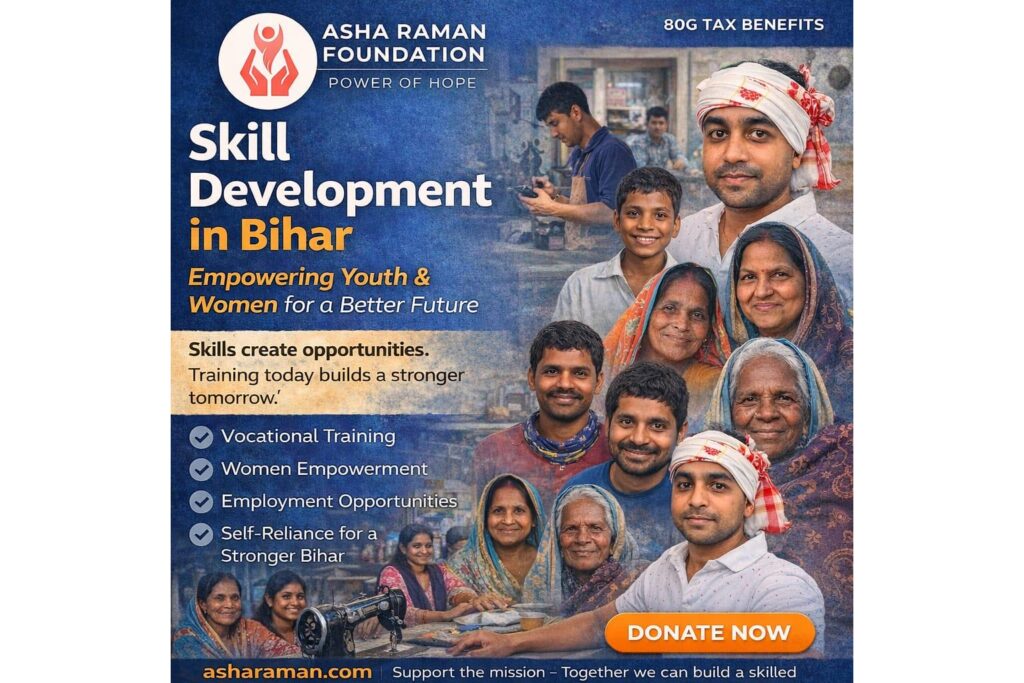
Empowering Rural Futures: How Asha Raman Foundation Is Transforming Youth and Women Through Skill Development in Samastipur (Bihar India)
Skill development has become one of the most important tools for social and economic transformation in India. In rural regions of Bihar, where employment opportunities are limited and migration is common, learning practical skills can significantly improve the quality of life for young people and women.
In districts like Samastipur, a large section of the population consists of youth. This demographic strength holds immense potential for development. However, many young people struggle to find stable employment even after completing their education. Without access to practical training and vocational skills, securing meaningful work often becomes a challenge.
One of the primary reasons for this issue is the gap between education and employable skills. Many students complete their schooling but lack exposure to technical training or real-world job skills. As a result, thousands of young people from rural Bihar migrate every year to cities in other states in search of work.
Recognizing this challenge, the Government of India launched the Skill India Mission in 2015. The mission aims to train millions of young people in different vocational fields and improve their employability. It encourages youth to learn practical skills that can help them secure jobs or start their own businesses.
A key program under this mission is the Pradhan Mantri Kaushal Vikas Yojana. Through short-term training programs, the scheme provides young people with opportunities to learn skills in sectors such as retail, healthcare, construction, electronics, and computer operations. These programs aim to prepare youth for employment in growing industries.
However, in many rural parts of Bihar, access to such training remains limited. Villages often lack training centers, infrastructure, and reliable transportation. For many young people in remote areas of Samastipur, traveling long distances to attend training programs is difficult and sometimes impossible.
Another challenge is the lack of awareness. Many rural families are not fully informed about the skill development programs available to them. As a result, young people often miss opportunities that could improve their careers and livelihoods.
Financial constraints also prevent many students from pursuing training. In economically weaker households, young people sometimes leave school early to support their families. This reduces their chances of gaining professional skills that could lead to better employment.
Women in rural Bihar face even greater challenges. Social traditions and limited educational opportunities often restrict women from participating in the workforce. In many villages, women have limited access to training programs and economic opportunities.
Skill development can play a transformative role in changing this situation. Training in activities such as tailoring, handicrafts, food processing, and small-scale entrepreneurship enables women to generate income from home. These skills not only improve their financial independence but also strengthen the economic stability of their families.
When women earn income, the impact extends beyond the household. Women often invest their earnings in the education, health, and nutrition of their children. This creates a positive cycle of development that benefits the entire community.
In this context, community-based organizations have a crucial role to play. They bridge the gap between government programs and rural communities by spreading awareness and encouraging participation in skill development initiatives.
One such organization making a meaningful difference in Samastipur is Asha Raman Foundation. The foundation has been actively working at the grassroots level to promote education, awareness, and skill development among youth and women in rural communities.
Through community outreach programs, awareness drives, and local engagement, the foundation encourages young people to explore skill training opportunities. It motivates them to learn practical abilities that can open doors to employment and entrepreneurship.
The organization also focuses on empowering women by promoting livelihood skills. By encouraging women to participate in training programs and develop income-generating skills, the foundation helps them move toward financial independence.
In villages across Samastipur district, such initiatives are helping build confidence among young people and women. Community engagement activities conducted by the foundation emphasize the importance of education, vocational training, and self-reliance.
Skill development brings several long-term benefits to society. It improves employment prospects and strengthens household incomes. Skilled individuals are more capable of finding stable jobs or launching small businesses within their communities.
At the same time, skill training helps reduce poverty. When individuals earn steady incomes, families can afford better education, healthcare, and living conditions. This leads to overall community development and improved quality of life.
A skilled workforce is also essential for economic progress. Industries and service sectors require trained workers to function efficiently. When rural youth acquire vocational skills, they can contribute to local development rather than migrating in search of work.
Encouraging youth participation is therefore essential. Young people should be guided to learn modern technologies, digital skills, and communication abilities that are increasingly important in today’s economy.
Schools, community centers, and social organizations can work together to promote skill education and career awareness at an early stage. This cooperation can help students discover opportunities and plan their futures more effectively.
Organizations like Asha Raman Foundation play an important role in this transformation. By connecting communities with knowledge, training opportunities, and motivation, they help create a culture of learning and self-reliance in rural areas.
The future of Bihar depends greatly on the empowerment of its youth and women. With sustained efforts from government initiatives, local organizations, and community participation, districts like Samastipur district can build a stronger and more skilled workforce.
Skill development is not only about employment—it is about dignity, confidence, and the ability to shape one’s own future. By investing in skills today, communities can create a more prosperous and self-reliant tomorrow. Asharaman.com
Gunja Jha
Editor- Insightfultake.com